COMMIT AND CHECKPOINT.
Whenever an Insert, Update or Delete statement is successfully executed, DB2 writes two types of log records, Undo Record and Redo Record.
For the sake of simplicity log records such as Begin UR, End
UR, Two Phase Commit etc. have been omitted from discussion.
Undo records are used by DB2 to rollback
any changes if the application wishes
to rollback or if there is an
abnormal termination of the thread.
The redo records are used for forward recovery.
COMMIT :
For example, Let us assume
that a SQL updates 100 rows of a table that belong to 10 pages in the
table
space. To perform these updates DB2 has to read these 10 pages from the
disk to
the buffer pool and the data changes are made in the buffer pool. Even
if a
COMMIT is issued after the update there is no guarantee that the
updated data
buffers will be written to disk. The only thing DB2 does at commit is
to write
the Undo and Redo Records from the log buffer to the active log data
set which
resides on disk.
In case DB2 terminates abnormally after the COMMIT was issued but before the data buffers were written to the table space, we end up with a situation where we think the data is committed but in reality this data has not been externalized to DASD.
To resolve this problem, when DB2 is brought up the next time DB2 reads the Redo records from the Active Log Data Set and even the archive log data sets and uses the Redo Records to essentially re-do all the work it did but crashed before it could move it to disk. Redo Records are also used while Recovering a table spaces.
Let us look at how the Log buffers (OUTBUFF) are written to and how the log buffers are written. The Active Log Data Set is a VSAM dataset, therefore the basic unit of I/O to it is in (blocks) Control Intervals (CI) . The point that is stressed here is that DB2 does not write to the Active Log Data Set Log record by Log record. Instead DB2 writes CI at a time .
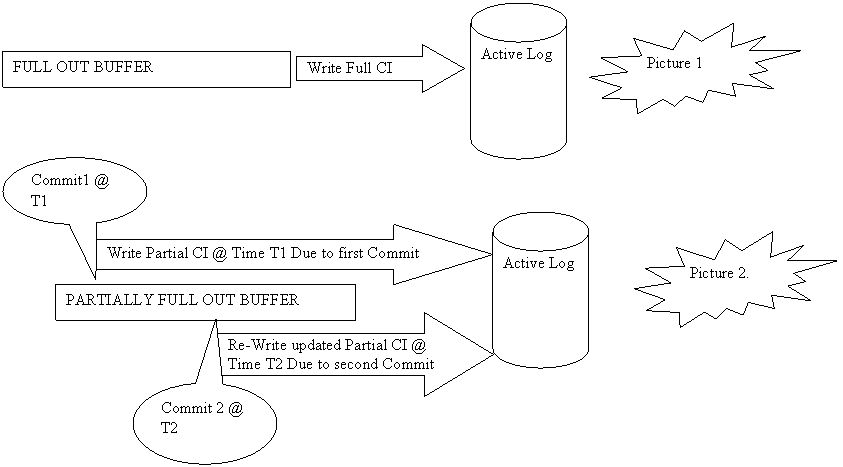
Let us first consider a simple situation. When SQL statements that modify data are being executed, log records will be written to the OUTBUFF. When the OUTBUFF becomes full, DB2 will write it to one CI in the Active Log Data Set. Follow Picture 1.
Next, let us assume that the OUTBUFF is not full and when it 10 % full, at time T1, PROGA ( some arbitrary program) issues a COMMIT. Even though the OUTBUFF is not full, DB2 will write the available log records as one CI to the Active Log Data Set. Obviously only 10% of the CI 's space will be used.
Assume at time T2 when the OUTBUFF is 50% full an other commit is
issued by either the same program PROGA or an other program PROGX, and
there are
many other log records that have been accumulated in the OUTBUFF that
might belong
to other units of work other than the one issuing the commit. At
this point an other write will be done to the Active Log Data Set.
However the CI
being written at T2 will not be a new CI but the updated version of the
CI that was written at T1. The CI written at T2 will have the log
records that were written at T1 plus the new log records that have been
accumulated till T2 .
The point that is stressed here is that every time a commit is issued a CI is written to the Active Log Data Set but it is not necessarily a new CI. Follow Picture 2.
There is no guarantee of any other data being externalized at
COMMIT other than the log buffers.
CHECK POINT:
Checkpoint on the other hand is a system wide event. A
check point can be triggered by a Coordinator like IMS/DC or CICS or by
DB2's LOGLOAD or by stopping DB2 etc..
When a checkpoint is
issued the
OUTBUFF is written to the Active Log Data Set as a full and non
updatable CI. The
data buffers are requested to prepare for writing the updated
pages to
the ( table spaces or indexes ) DASD. After the
checkpoint is taken
the Boot Strap Data Sets are updated with the Checkpoint Start and End
RBAs.
Checkpoint does not ensure that the data
buffers are externalized.The
only constraint is that the data buffers have to write the updated
pages before the next two check points. ( Note: for example, If you want to ensure that all your
log information is externalized and all your data buffers are
externalized before you take a flash copy , issue three consecutive check points and
then take the flash copy ).
Apart from this a check point will also check for any datasets
that might need to be pseudo closed based on PCLOSEN parameter.